Retained Tire-Label Samples: Which Reference Should a Reorder Match?
Published
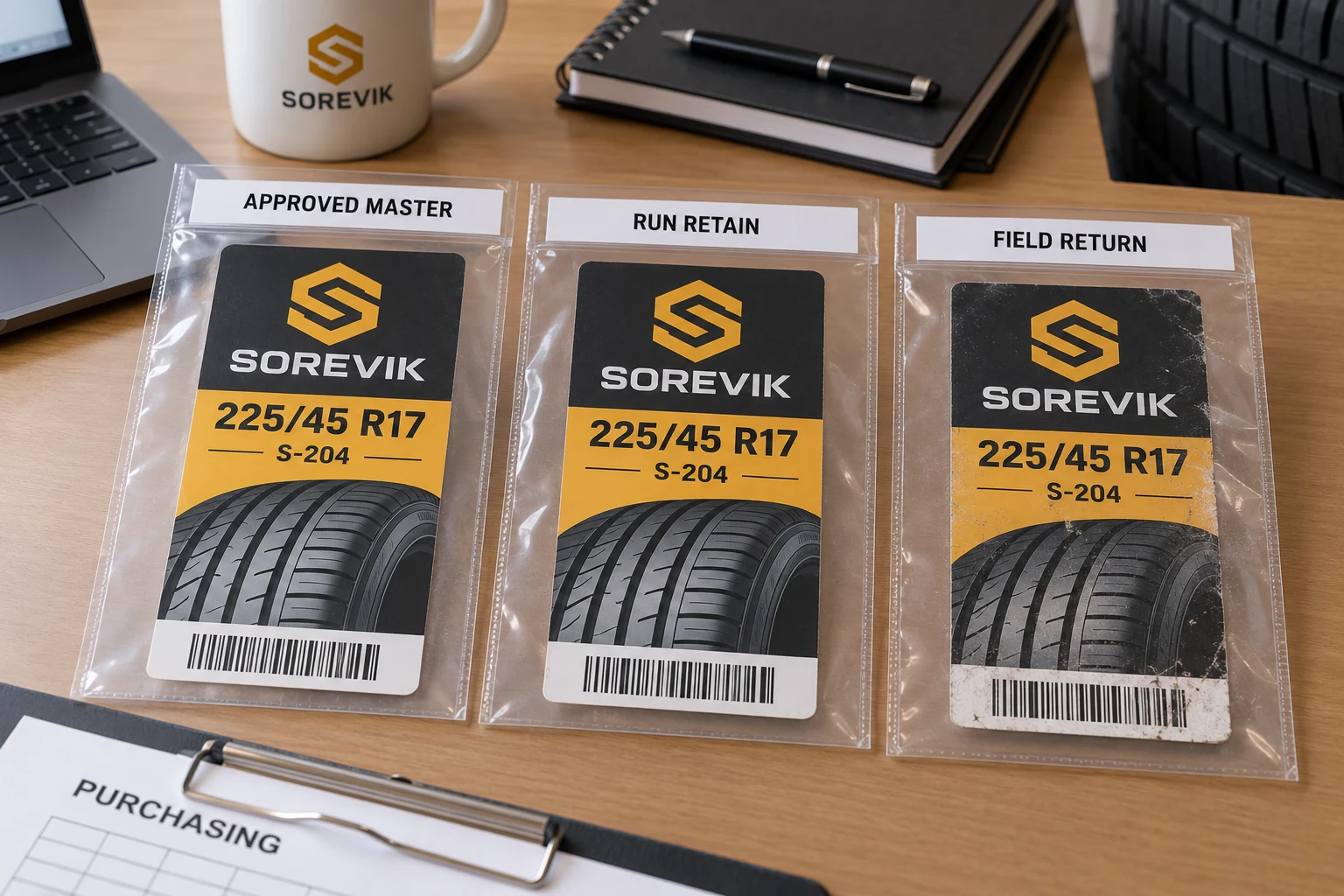
Three samples arrive at the review desk: the label signed off before production, a label kept from the delivered run, and a worn label removed from a tire. They disagree slightly. Asking the next supplier to match the sample is not a complete instruction until someone names which sample and what aspect of it governs.
Give each reference a defined role. An approved master records an accepted design or construction within its stated scope. A production retain represents a particular supplied run. A field return records what happened to one label after use. Keep those roles distinct before judging a reorder.
A reference needs a history
Attach the artwork revision, construction reference, batch or order identity and relevant approval to each retained sample. Record when it was collected and how it has been held. A loose label in a drawer may still be useful, but its missing history limits what it can establish.
Do not improve the record by guessing. If the sample's batch is unknown, say so. If it was removed from a tire, note that its current adhesive surface and shape may no longer represent an unused supplied label. Preserve it as an observation rather than silently promoting it to a production master.
The storage guide explains why construction-specific storage information matters. A retained sample is subject to its own history too; keeping it does not freeze every material property indefinitely.
Name the comparison being requested
A sample may be authoritative for printed content but unsuitable as the sole color reference. It may show the accepted layout while lacking the current code payload. The approval scope should say which attributes the reviewer intends to compare.
For a reorder, separate artwork identity, readable data, appearance, dimensions, construction and intended application. Some require controlled files or specifications in addition to physical samples. Matching an old label by eye cannot establish an unseen adhesive formulation or reconstruct a missing data rule.
Consider an illustrative field return with a faded brand panel. It can support a discussion about observed appearance after use. It should not instruct the printer to reproduce that faded color as the new target unless the brand owner deliberately approves a new design.
Build a reference hierarchy the buyer can explain
| Reference | Useful role | Limit |
|---|---|---|
| Approved artwork and data | Content, layout and identifier authority | Does not establish physical performance |
| Approved physical master | Agreed attributes under its documented scope | May age; may not cover later revisions |
| Production retain | Evidence of a named delivered run | Does not automatically redefine the approved target |
| Field return | Observed condition after a stated use history | Exposure and removal may be incomplete or uncertain |
| Unidentified sample | Discussion aid | Cannot settle provenance-dependent decisions |
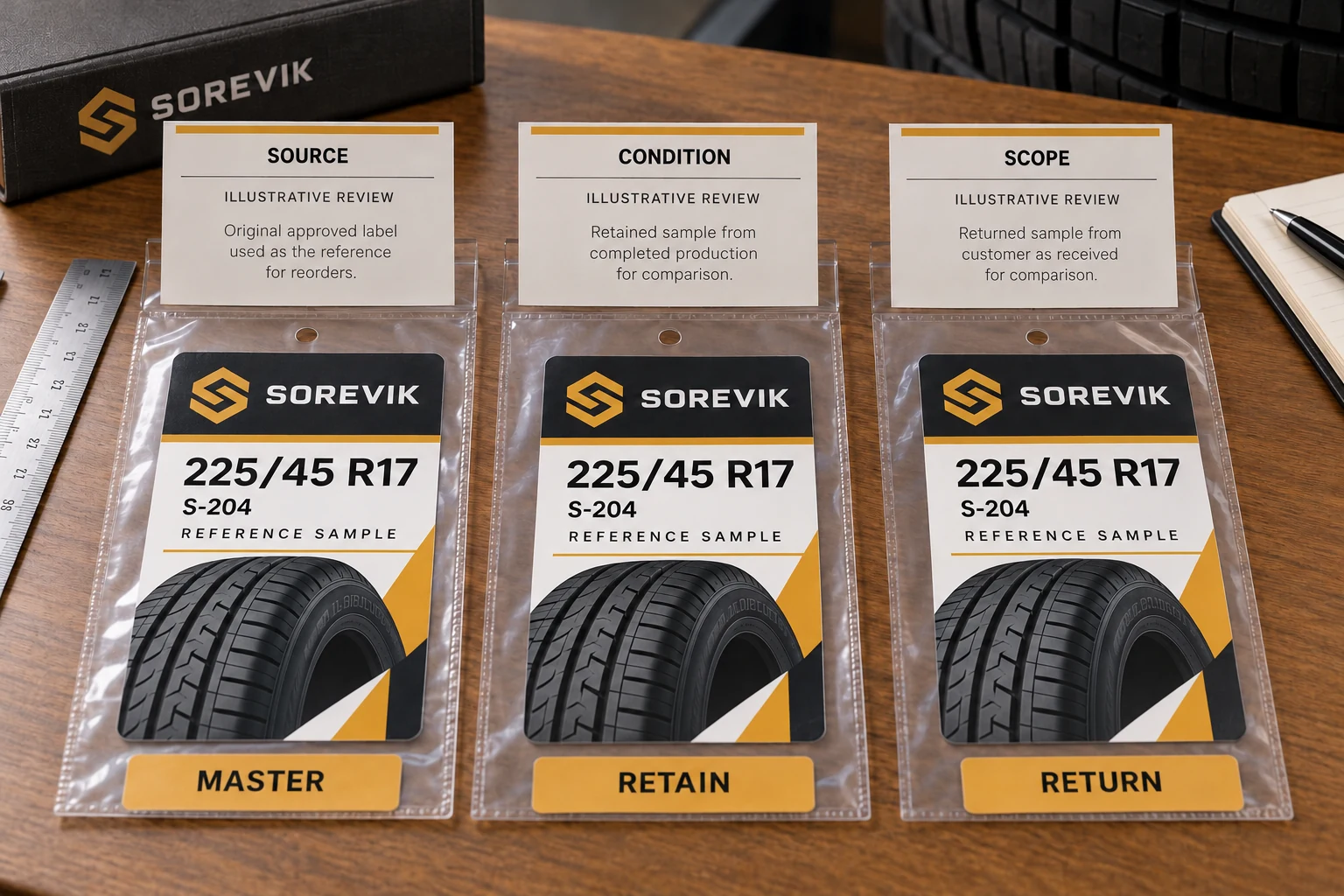
The hierarchy is a proposed purchasing record, not a universal contractual rule. Agree which documents control with the relevant parties before an acceptance dispute. Conflicting references need owner resolution rather than a supplier choosing whichever is easiest to match.
Keep a production retain without confusing it with approval
Identify the run and where the retained material came from. State whether it is an unused label, a section of roll or an applied sample. Preserve any packaging information needed to connect it to the supplied construction and order.
The lot-acceptance guide addresses how a shipment decision is made. A retained piece can support that record, but its existence does not prove the whole lot passed an agreed sampling plan. Do not label it passed unless the associated decision actually exists.
Choose a retention quantity and period appropriate to the project's real requirements. This article supplies no universal number. Ask what future question the sample is meant to answer and whether the storage arrangement can preserve the attributes relevant to that question.
Use field returns to refine the question
When a used label differs from the master, record what is visible before assigning a cause. Was the print rubbed, the edge lifted, the label stretched during removal or the color altered? Which part of the handling history is known?
Compare a field return with a suitable unused reference where available. Keep the conditions and limits explicit. A difference can justify further investigation without proving a material defect, and an unchanged unused retain cannot prove that every applied label experienced the same conditions.
If the original complaint concerns scanner access or poor placement, buying a construction that looks more like the retained sample may miss the issue. The retained material should help locate the decision, not become an automatic argument for reordering or rejecting stock.
Retain the existing target when it remains suitable
If the current approved design and construction still meet the requirement, a reorder may need no redesign. Confirm that the source files, data and applicable sample references remain current, then identify any proposed supplier or process changes separately.
If the only available master has uncertain provenance or has visibly changed, rebuild the approval basis using controlled artwork, specifications and a new agreed sample. Do not treat that exercise as proof that the old supply was defective. It is a way to restore a dependable future reference.
For custom tire labels, prepare a reference-sample brief with photographs of each sample, its known history, the attributes to match, approved files, dimensions, construction reference and quantity. Organize the requirements on the contact page and send supporting files through email or WhatsApp. The first useful decision is which reference answers which question.