Resource Guide
Tire Label Roll Changeover: Keep Adjacent Sizes and Revisions Apart
Two rolls can share the same color and almost the same tire size. At changeover, the question is not whether the artwork looks familiar; it is whether the roll, job ticket and first applied label agree.
Published 2026-10-02
Digital proof before production. Material and adhesive options are discussed according to your application requirements.
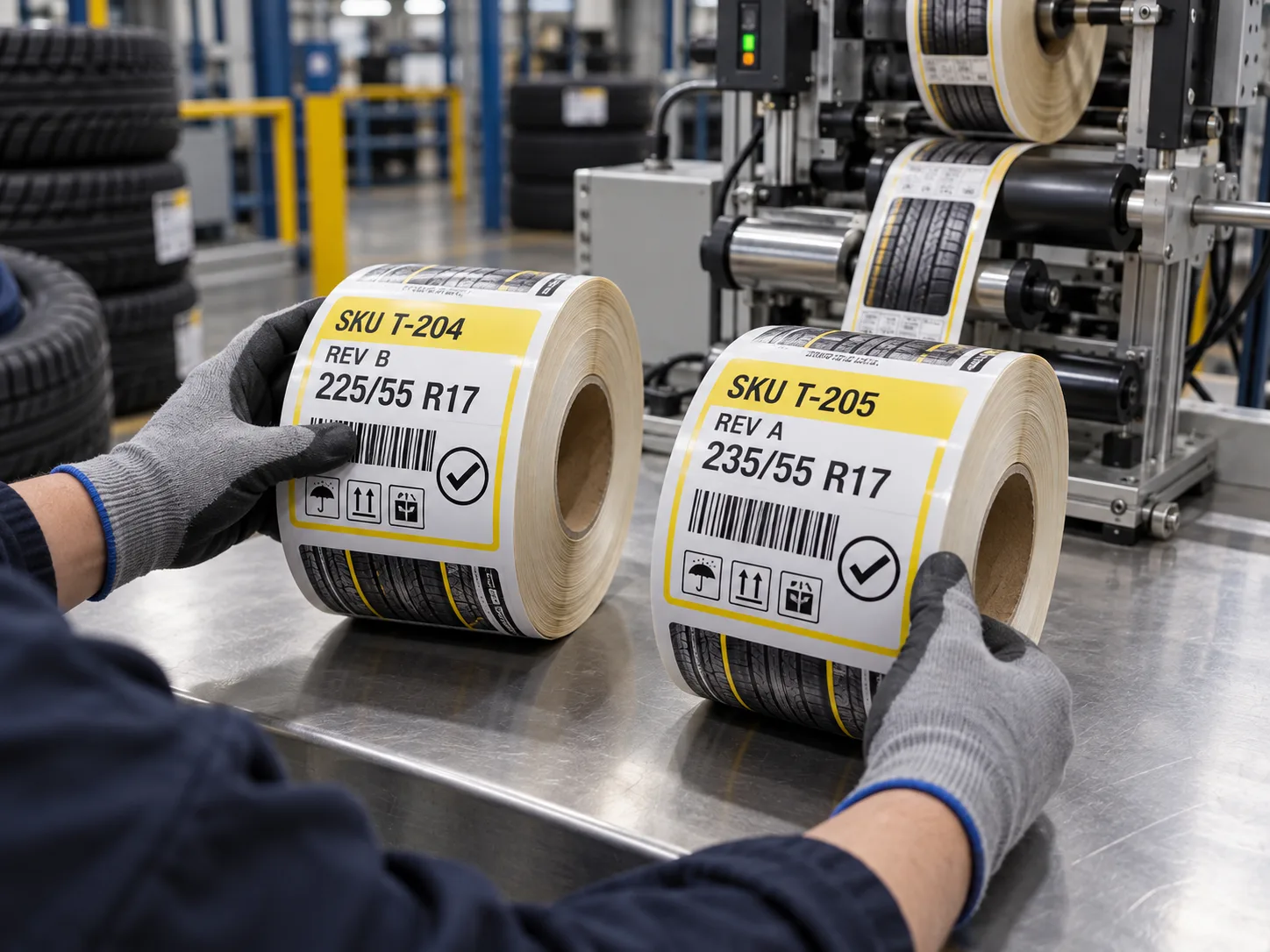
Quick Answer: Make the Roll Tag a Handoff Record
Give each supplied roll or carton a legible external identity that connects it to the buyer approved SKU, tire size, artwork revision and quantity. If a line applies more than one version, keep those fields visible before the wrapper is removed. The roll tag is a production-control aid, not the consumer tire label. Ask the supplier how partial rolls will be identified so an open core cannot return to stock with only a handwritten guess.
An Illustrative Ten-Minute Changeover
Imagine an operator switching from 225/55 R17 to 235/55 R17 after a short run. The yellow label design hardly changes. One unopened roll is beside the machine; a half-used roll is still on the spindle. This is a composite example, not an actual defect report. A glance at color will not settle which one belongs to the next order. Compare the job ticket, outer roll ID and first printed or applied label before releasing the line. Hold the previous roll in a named location rather than placing it on the next cart.
Control Four Places Where a Mix Can Start
Check the approved artwork file before printing, the roll and carton tags at receipt, the staged roll at the applicator and the first labeled tire after restart. Record who approves a revision and how obsolete labels are segregated. A finished label can have a perfectly sharp barcode yet encode the previous size. If the line prints variable data in-house, add the active data file and printer job to the check. If rolls arrive fully preprinted, verify the sample against the order matrix.
- ORDER: buyer SKU, tire size, market or buyer variant, artwork revision and quantity.
- ROLL: external tag, core or wrapper ID and partial-roll rule.
- LINE: current ticket, applicator orientation, old-stock removal and staged roll.
- FIRST TIRE: human-readable size, code payload and applied position.
- HOLD: who quarantines a doubtful roll and who authorizes release.
A Sample Approval Is Not a Changeover System
A digital proof confirms one approved design; it does not tell an operator which roll is on a cart next week. Keep the proof tied to a controlled SKU matrix and clearly distinguish similar versions on outer packaging. The label face may also carry a revision if the buyer wants it, but do not add uncontrolled text to product artwork. A machine-readable roll code can assist, yet the scan should resolve to an approved job record rather than just echoing a roll number. Test the exact handoff at the line.
What to Include in the RFQ
Send the number of SKUs, artwork revisions, size differences, forecast quantities, winding direction, core and maximum roll size, dispenser details, variable-data ownership and labeling requirements for every outer roll. Ask how the supplier handles partial rolls and a revision change after printing. Agree on a first-article check and a receiving sample. The cheapest roll is expensive if the team must open every carton to discover which tire it belongs to.
FAQ
Questions Buyers Ask
Is a barcode on the roll tag enough to prevent a mix?
Only if its record maps to the correct approved SKU, revision and active job, and the team actually checks it at changeover.
Should the tire label itself show the artwork revision?
That is a buyer approval decision. The external roll tag should remain clear even when a revision cannot be added to the product label.