Resource Guide
Tire Tread Labels: Roll or Sheet for Manual Application?
A roll looks efficient on a quote. A sheet can make a small, mixed-SKU bench easier to control. The right format depends on who peels the label, how often the job changes and where unused stock goes.
Published 2026-10-03
Digital proof before production. Material and adhesive options are discussed according to your application requirements.
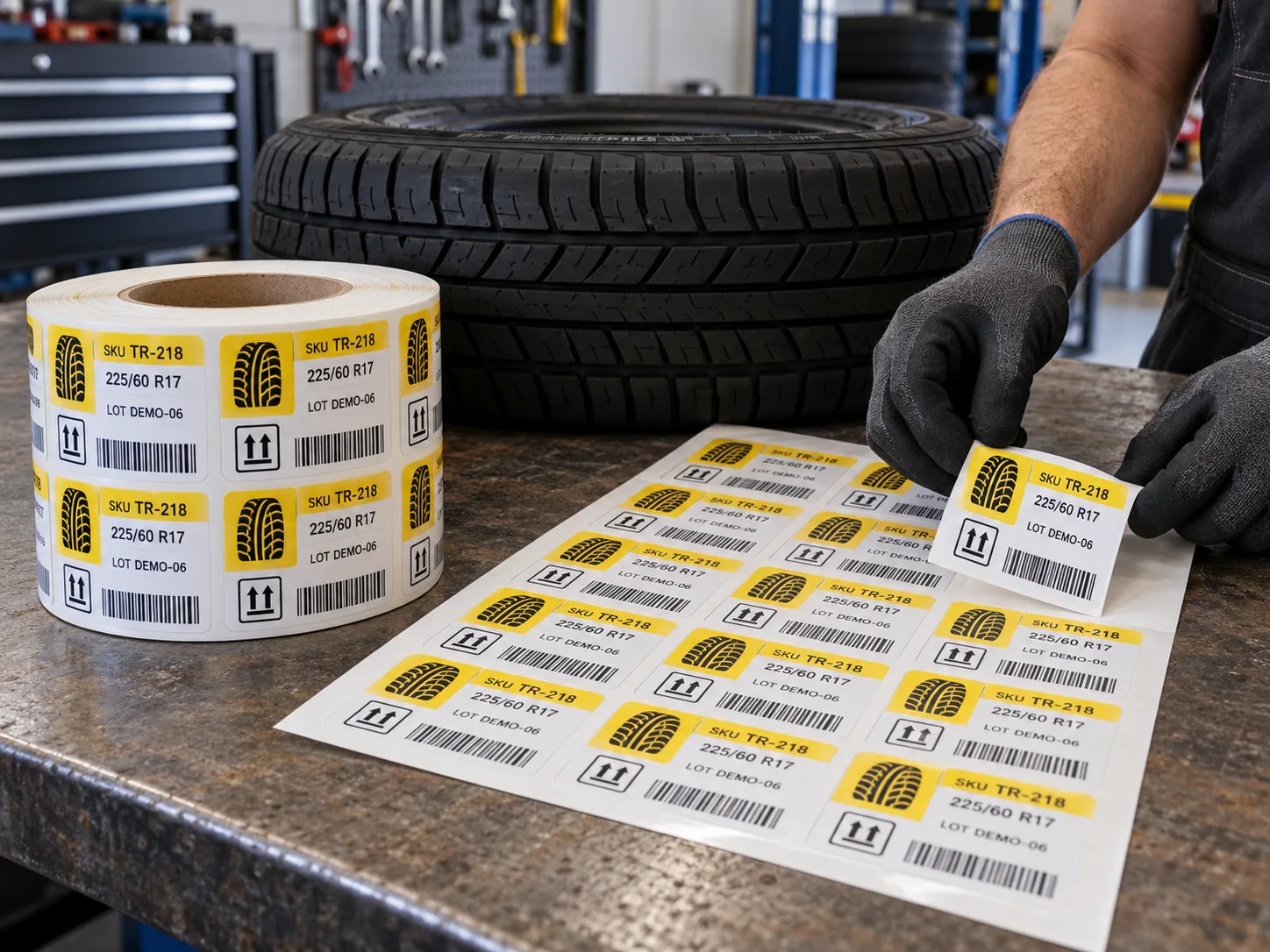
Quick Answer: Watch One Application Cycle
For repetitive application of one tire SKU, a roll can keep labels in sequence and reduce handling of individual sheets. For short runs or many designs at one bench, sheets can make versions easier to separate and count. Those are workflow tendencies, not universal speed claims. The liner, adhesive, die-cut shape and finished label construction still need to suit the tire surface. Ask one operator to apply a small sample batch using both proposed formats before ordering a large quantity.
An Illustrative Mixed-Size Bench
Imagine a worker labeling two tire sizes in the same afternoon. The first size has a full roll at the bench; the second needs only a few dozen labels. This is a composite buying scene, not a customer case. A second roll may be convenient if each run is clearly separated. A sheet may be easier if the order changes repeatedly and partial rolls otherwise return to a shelf without reliable tags. The cost question is not only price per label. It includes counting, changeover, storage and the chance of selecting the wrong artwork.
What Changes When Labels Come on a Roll
Specify core size, outside diameter, winding direction, label pitch and maximum roll weight only if your dispensing method requires them. A hand-applied roll still needs a practical place to sit and a way to keep its outer tag with the remaining stock. If several SKUs share the same color and shape, print the SKU and artwork revision on the carton and each roll wrapper. Do not assume a machine-applicator specification is necessary for a simple hand bench.
- Volume: labels used in one uninterrupted run, not just annual total.
- Variants: number of tire sizes and artwork revisions at the station.
- Method: hand peel, tabletop dispenser or automatic applicator.
- Stock: how unopened, opened and partial rolls are identified.
- Proof: finished-size label applied to the actual tread.
What Sheets Solve, and What They Do Not
A release-liner sheet can present one design at a glance and help an operator count a small batch. It can also bend, collect dust or be mixed with another stack if the storage process is weak. Confirm how many labels are on each sheet, whether margins allow easy peeling, how sheets are packed and how unused sheets return to inventory. A sheet format does not make a weak construction stick better. The adhesive decision remains tied to the tire surface and application conditions.
A Quote Brief That Separates Format From Material
Send a tire photo, label dimensions, number of versions, quantity by SKU, expected labels per shift, hand or dispenser method, storage plan and artwork file. Request the same label construction in a small roll and sheet sample if the format remains undecided. Compare application motion and stock control, then approve the format that your team can repeat without improvising. A supplier should not promise a universal speed advantage without seeing the actual bench.
FAQ
Questions Buyers Ask
Are roll labels always cheaper than sheets?
Not necessarily. Compare the quoted construction and order quantities along with handling, changeover and unused-stock costs.
Can the same artwork be supplied on rolls and sheets?
Often the print artwork can be shared, but liner layout, die-cut spacing and packaging should be proofed for each agreed format.