GS1 Logistic Label Guideline
Official guidance on logistic-unit identity and labels outside wrap.
View detailsResource Guide
A tread label can identify a tire before the load is wrapped. Once film and straps cover the stack, the receiving dock may need a separate outer pallet identifier. Plan that scan point before the wrapping station.
Published 2026-10-01
Digital proof before production. Material and adhesive options are discussed according to your application requirements.
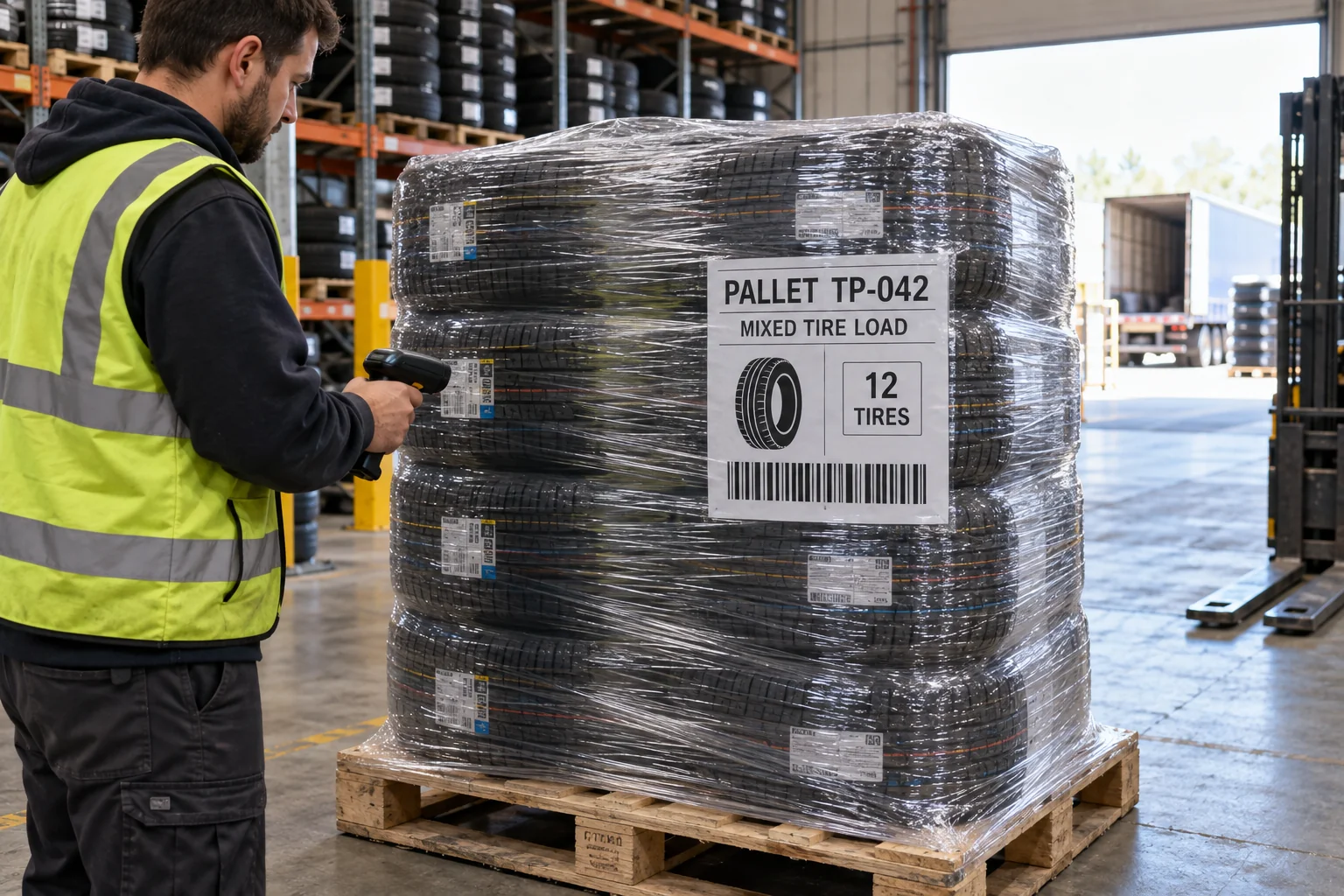
Do not rely on a worker reading small tire labels through layers of stretch film. Decide which identifier the receiver scans for the pallet and apply the approved outer label after wrapping where it stays visible. GS1 logistic-label guidance describes identifying combined wrapped pallet groups with their own logistic-unit identifier and placing the master label on the outside of the wrapping. That specific GS1 rule applies when the shipment follows the relevant GS1 scheme; an internal system may use a different approved pallet ID. The label printer should not invent an SSCC.
Official guidance on logistic-unit identity and labels outside wrap.
View detailsImagine a stack of mixed tires with neat tread labels before wrapping. After two film passes and a cross-strap, the closest code sits behind a fold. The driver scans a different tire and the system shows only one SKU, not the whole load. This is an illustrative scenario, not a real shipment. The remedy is to preserve tire-level IDs for item handling while giving the wrapped pallet its own outer ID linked to the approved contents record. The pallet label is a doorway to that record, not a list of every tire unless the receiving requirement says so.
The operations owner should define whether the unit is a single-SKU pallet, a mixed pallet, or a stack of separate pallets joined for shipment. Record the data owner, the point where the ID is issued, and what happens if the wrap is removed or the load is split. If the outer label carries an SSCC, allocate and encode it under the trading partners GS1 rules. If it carries an internal number, do not dress it as a GS1 identifier. Keep the human-readable pallet ID large enough for manual recovery, and place the symbol where the actual dock reader can reach it.
Apply finished-size labels to the actual film or an approved label panel on a representative wrapped pallet. Check whether film tension, corners, overlap, condensation or handling makes edges lift. Scan at the real dock distance with the device used by the buyer. Photograph the final position and keep it in the packing instruction. A barcode that verified on a flat bench can still be hard to access on a curved stack or under a strap. Do not treat a successful scan through film as a substitute for a defined outer label.
Send tread-label artwork and pallet-label artwork as separate files. Supply the tire SKU file, pallet-data format, wrap type, application timing, roll or sheet preference, expected quantity and scanner details. Tell the printer which fields are variable and who provides the data. This site can discuss custom printed labels; the buyer owns pallet aggregation and shipping records. Request a proof at the final size on a wrapped sample before bulk printing.
FAQ
Usually not when it only identifies one tire and becomes hidden after wrapping. Define the wrapped unit and its record separately.
Only when the shipping scheme calls for a correctly allocated GS1 logistic-unit identifier. The label printer should use buyer-approved data.