Matching Printed Tire Labels to RFID: Name EPC, TID and the Business ID
Published
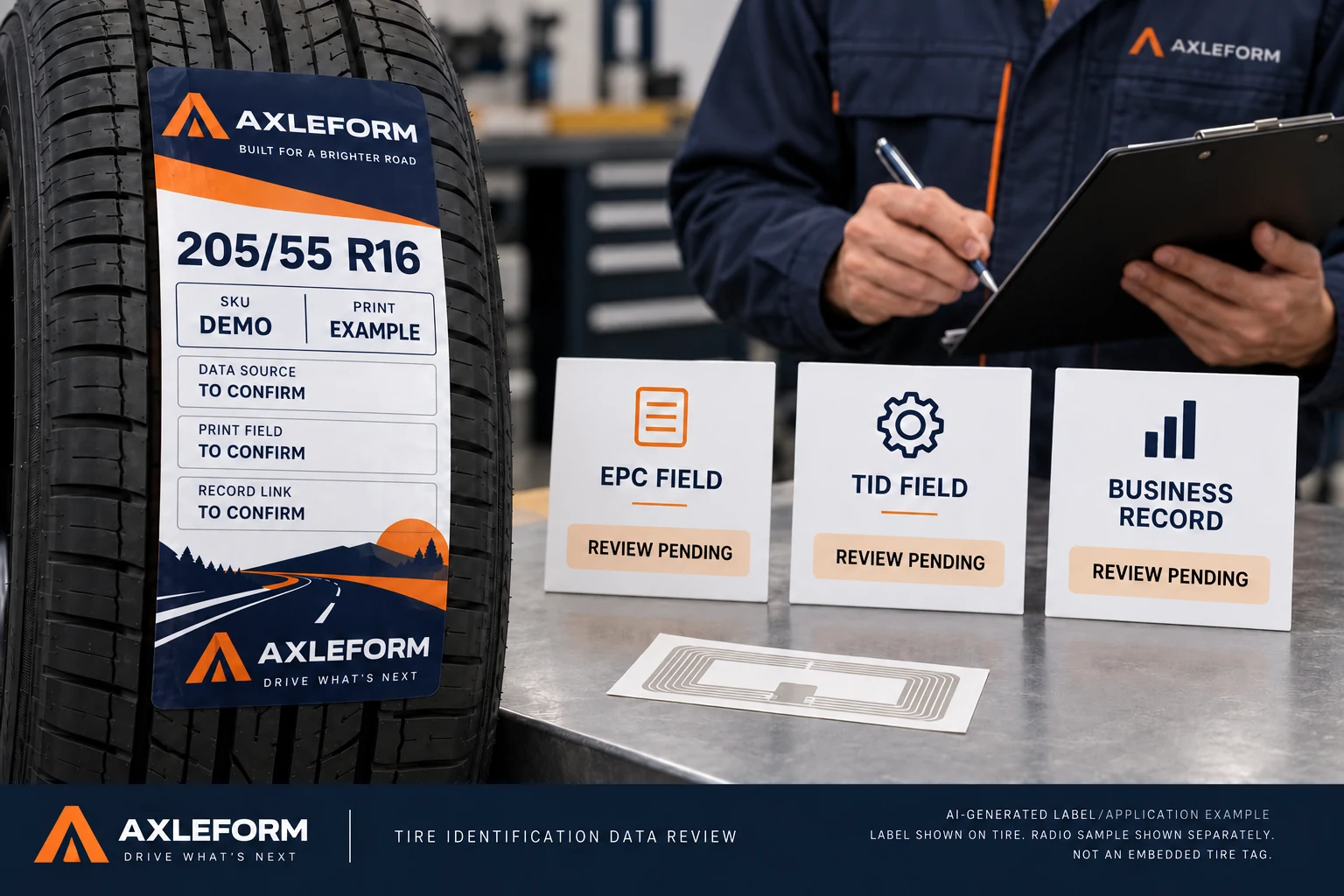
The reader export has a column called ID. The label buyer asks the printer to put that value beneath a barcode. Nobody has stated whether the column contains an object identifier, tag information or an application-specific display.
Before copying the string, have the RFID and data owners name the field and its representation. Then define how that value relates to the tire record and what the printed label must carry. Two readable carriers do not prove that they identify the same kind of thing.
This guide addresses the data handoff within an existing RFID project. It does not offer embedded tire RFID, program a tag or prescribe an encoding scheme. The printed-label requirement should remain explicit even when another provider owns the radio system.
A reader display needs a field name
Ask the integration owner what the exported column represents and where it comes from. Retain the reader or application configuration reference relevant to that output. An unexplained column called serial or ID is not enough for production data approval.
GS1 GO's RAIN RFID memory explanation distinguishes EPC memory, which carries the object identifier, from TID information describing the tag and its capabilities. It also describes optional user memory and qualifications around serialized TID and tag generations. Do not assume every historic tag has the same fields or that any displayed tag value is the tire's business identifier.
The useful procurement action is to ask which field the actual workflow uses. There is no need for the label designer to guess a memory bank or derive a number by visual inspection of a reader screenshot.
Record the representation, too
A named field can be presented in more than one form by software. Ask the owner to provide the approved representation for the handoff and explain any transformation between the reader's output, printed payload and application lookup.
Do not remove characters, pad values or convert a displayed string simply to match another column's length. Such changes need an owner-approved rule. Keep an example source record with its expected printed result so a reviewer can follow the actual mapping.
The existing RFID-versus-printed tire label guide establishes why both carriers may be useful. This additional record makes its mapping requirement concrete: name the source field, the representation and the business record rather than treating a successful radio read as a complete print brief.
Separate product identity from one tire instance
The visible tread label may be intended to identify a tire product or SKU, while another carrier identifies an individual tire instance. That can be a deliberate arrangement. It becomes a problem when the buyer expects an instance-level fallback but supplies only a product-level value.
Have the data owner state the required identity level. If the printed value is SKU-level, retain that description and the approved relationship to any instance data. Do not advertise it as unique tire identification simply because the code looks detailed.
If an individual tire record must be recovered through either carrier, document that requirement and demonstrate the owner-approved relationship in the actual system. The label supplier cannot establish it from the tire size, an inlay photograph or an export column name.
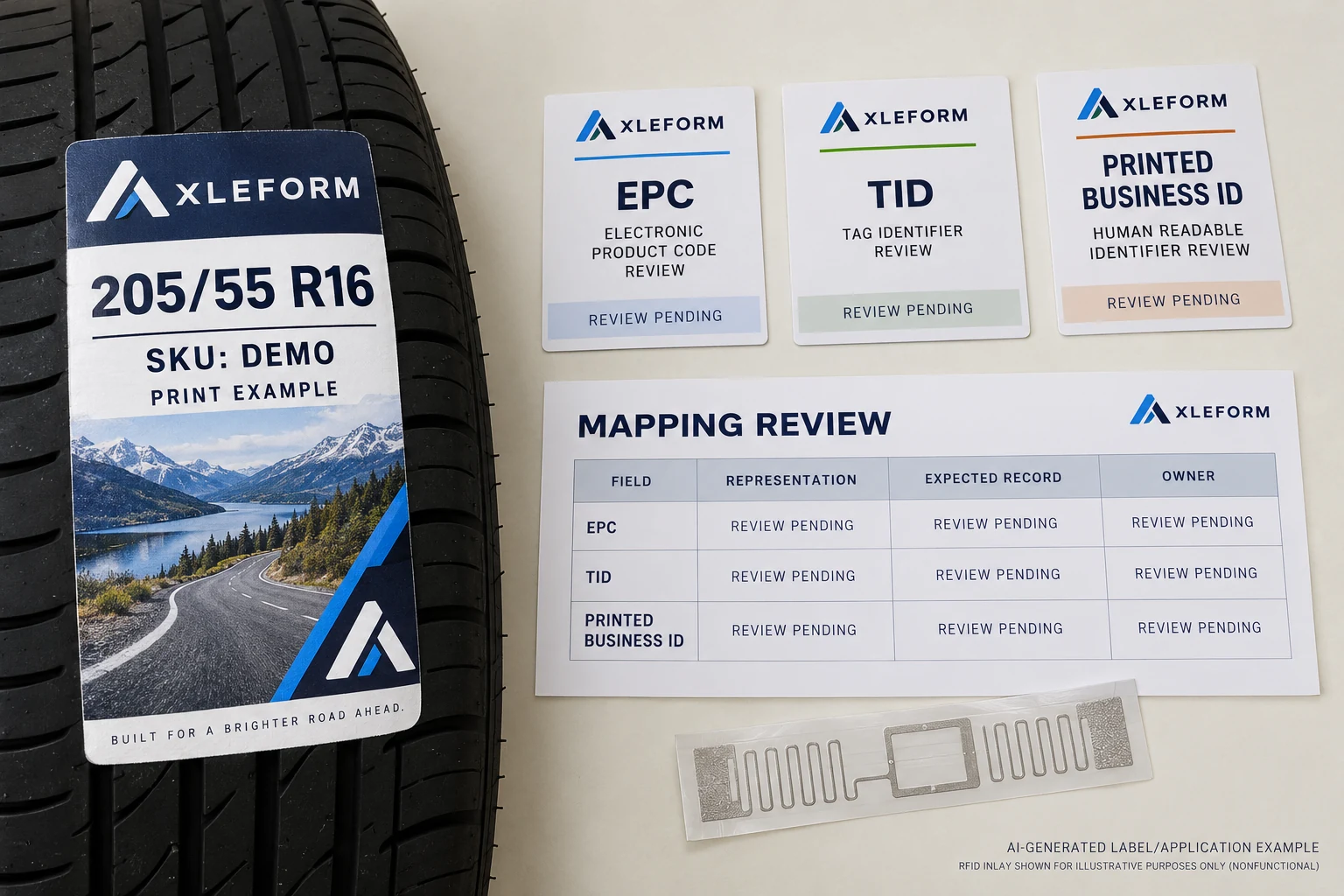
Use one mapping record for the sample
Bring the radio and optical reviewers to the same reference. A useful record can be short:
| Field | What the owner supplies |
|---|---|
| Physical reference | The tire or controlled sample whose identities are compared |
| RFID source | Named field and relevant output/configuration reference |
| Representation | Exact supplied form and any approved transformation |
| Printed requirement | Readable text, encoded payload, carrier and identity level |
| Business result | Expected record or lookup relationship and responsible approver |
Use controlled examples from the owner's actual project for approval. This article provides no production EPC, TID or tire serial. An illustrative value can explain the columns, but it cannot prove that a real record resolves correctly.
Compare the result through the intended application
Have the responsible system owner follow the selected physical sample through the radio read and the printed-label scan. Compare their actual outputs with the approved mapping and expected business result. Record exceptions rather than assuming that matching-looking text establishes the whole relationship.
Keep readability, data meaning and physical application checks separate. A readable barcode may carry the wrong approved field. A correct mapping may still need a suitable printed construction and scan position. Neither result proves that a tag is qualified for tire manufacturing or that a tread label can survive a cure process.
The duplicate serial guide addresses uniqueness and reprint control. A value can be unique within a defined scope while still identifying a tag rather than the business object expected by the application. That is why field meaning must be settled before uniqueness becomes reassuring.
Keep a simpler printed role when it is sufficient
If staff only need product size and SKU for picking, a clearly defined product-level printed label may be enough for that event. Maintain the owner-approved lookup to instance data where required, and state the limits of the visible label.
If the printed label is the required fallback for individual tire identification, do not downgrade it silently to a shared SKU to simplify the artwork. Compare the actual recovery task and the data available at that point. The right choice follows the required event, not the length of a reader string.
For tire barcode labels, I would ask the data owner for a named, approved print field. It gives the converter a usable instruction while leaving radio technology and business identity with their responsible owners.
Preparing a printed RFID fallback? Prepare an identifier-mapping brief with the named RFID field, representation, approved printed payload and readable text, expected business record, sample data, tire-surface photos, label dimensions and quantities. Organize the requirements on the contact page, then send supporting references through the existing email or WhatsApp path for a project-specific discussion.