Resource Guide
RFID vs Printed Tire Labels: Two Different Identification Jobs
An embedded RFID identifier and a printed tread label can coexist, but they answer different questions. Decide who must identify the tire, where, and with which equipment before ordering either.
Published 2026-09-30
Digital proof before production. Material and adhesive options are discussed according to your application requirements.
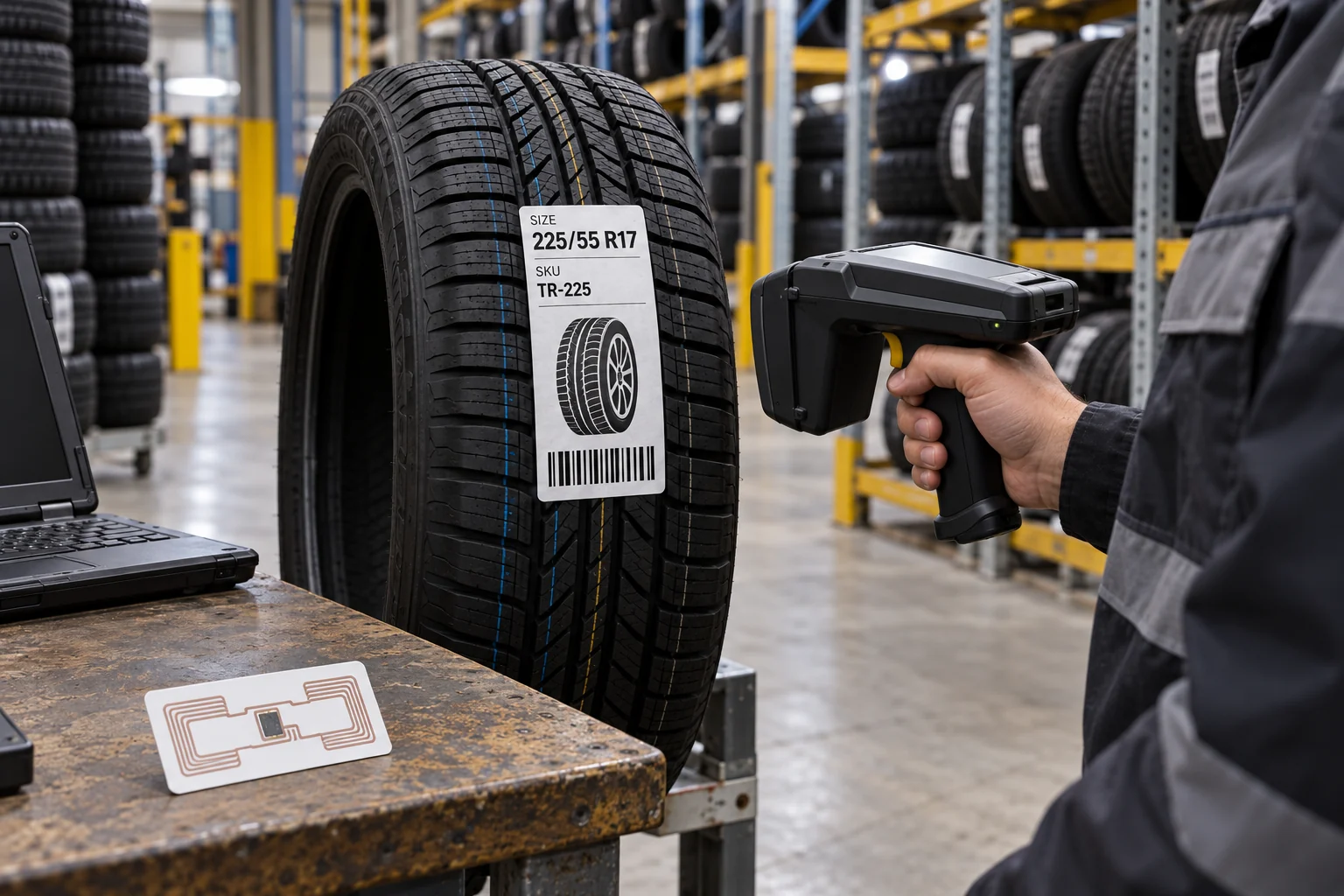
Quick Answer: Do Not Treat Them as Substitutes
RFID can identify a tire through a compatible reader without presenting a printed symbol to a camera. A printed tire label presents size, product information and a human-readable or optical code at the surface. Michelin describes its RFID technology as a passive identifier embedded in the tire. That is not a service this label website claims to provide. A printed label may still be needed for staff, receiving checks and systems without RFID readers. Agree on the identifier mapping before the graphics are approved.
A Receiving Dock Decision
Imagine a warehouse receiving mixed tires from two production lines. One line has embedded RFID; the other does not. A handheld barcode scanner is available at every unloading door, while RFID portals exist only in one aisle. This is an illustrative situation, not a customer case. A visible tire label gives workers a common fallback, but its data must resolve to the same approved SKU and batch record as the RFID identity. Two different serial schemes without a mapping table create an exception queue rather than a faster dock.
Choose by the Scan Event
Ask what the worker must know at the point of action. An automated portal may need a unique tire ID, while a person choosing stock may first need size, brand, pattern and a legible product code. Decide whether the visible code carries a product identifier, an individual serial, or a link to a record. Specify the scanner type and the physical scan angle. A printed symbol hidden under wrap or damaged by handling will not serve as a dependable fallback. RFID likewise depends on the selected tags, readers, integration and placement being validated by their providers.
- IDENTITY: who owns the product and serial data?
- EVENT: which locations read RFID, optical code or text?
- FALLBACK: what happens when one carrier cannot be read?
- MATCH: how is the printed value linked to the approved RFID record?
- REWORK: who may replace a damaged visible label?
What to Ask the Printed-Label Supplier
For the visible label, provide tire sizes, tread surface photographs, label dimensions, content hierarchy, artwork, data file, quantity and the application method. Tell the supplier whether the label is hand-applied, dispensed or applied in-line. Request a finished-size proof on the actual tire and check scan performance with the readers used by your staff. If RFID is in scope, coordinate that design with the tire and RFID system owner; a label quote should not be mistaken for a proposal to embed an RFID tag in the tire.
A Sensible Pilot
Run representative tires through receiving, storage and shipping. Record which identifier each station actually reads, any mismatch and the manual recovery path. Test different sidewall or tread geometries where labels will be applied. Approve the artwork only after the product master and data mapping are signed off. There is no universal cost or performance winner: the right combination depends on read points, infrastructure and the buyer workflow.
FAQ
Questions Buyers Ask
Does RFID remove the need for a visible tire label?
Not necessarily. People, receiving partners or locations without RFID readers may still require readable printed product information.
Can this label supplier embed RFID in tires?
This site describes custom printed labels, not embedded tire RFID manufacturing. Coordinate embedded RFID with the tire and RFID system providers.