Resource Guide
Tool Crib Labels: Tool ID vs Drawer Location
A drawer label tells a mechanic where a tool belongs. It cannot identify which physical wrench left the crib. The tool moves; the drawer usually does not.
Published 2026-10-16
Digital proof before production. Material and adhesive options are discussed according to your application requirements.
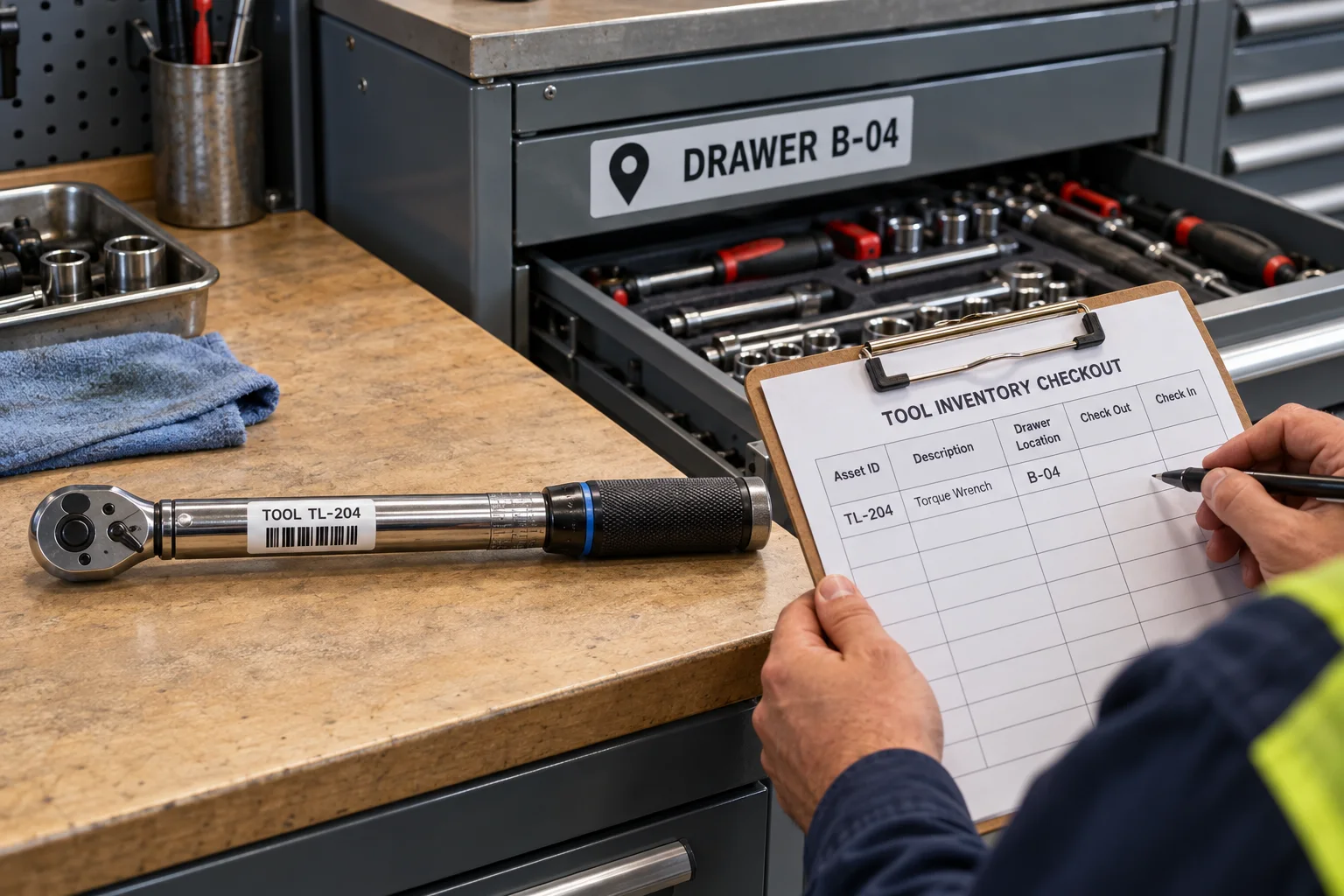
Quick Answer: The Tool Keeps Its Own ID
Give every unit that needs individual tracking a stable buyer-controlled tool ID. Label the storage position separately, for example DRAWER B-04. A checkout record links tool ID, location and current holder. If the tool moves to another drawer, update the location record rather than changing the permanent asset sticker. When the business only tracks a group, a bin label may be enough; do not print unique tags without a matching register.
Two Similar Tools in One Drawer
Imagine two torque wrenches in B-04. This is an illustrative tool-room scene, not a reported loss. One goes to Line A while the other stays for the next shift. Scanning B-04 proves only which drawer was opened, not which wrench departed. Distinct TL-204 and TL-205 IDs let the return desk reconcile units. An inventory tag does not establish calibration or fitness for use; those decisions sit in a separate controlled record.
Choose a Zone That Survives Use
Avoid the grip, adjustment scale, setting window and manufacturer marks. Photograph a representative tool from the angle workers actually scan, then measure a flat protected area. Describe oil, wipe-down, metal abrasion and storage contact. Very small or textured tools may need a different attachment method. A nice image cannot prove adhesion: test a finished sample during normal handling.
Make the Two Codes Visually Distinct
A tool ID should resolve to one physical item; a drawer ID should resolve to one position. If both use barcodes, add prefixes and clear words so a hurried worker can tell which field is being scanned. Test checkout and check-in using the real device. A successful decode does not prove the asset register is current. Keep calibration, service holds and asset identity under their respective owners.
Plan Replacement Without Duplicate IDs
Agree who may request a replacement tag, whether the old sticker must be removed and how a lost tool is retired. Pack tool-ID rolls and drawer labels separately with revision names. If a unit is scrapped, void its identifier under the buyer policy rather than silently applying that same number to a new wrench. If a drawer is reorganized, change the location sign and record, not every tool tag.
What to Send for a Quote
Supply photos and counts by tool type, available label areas, cleaning conditions, approved ID format, drawer naming rule, barcode or text requirements, scanner model and replacement policy. Ask for a mock checkout with two tools from the same drawer. That small trial reveals whether the print system supports the workflow.
FAQ
Questions Buyers Ask
Can every tool in a drawer share one barcode?
Only if the business tracks the group rather than the individual units. Unit-level checkout needs distinct IDs.
Does an asset sticker show calibration status?
No. Use the controlled calibration record and any separately approved status marking.